
Lavender Blue Dilly Dilly
Everyone's favorite herb
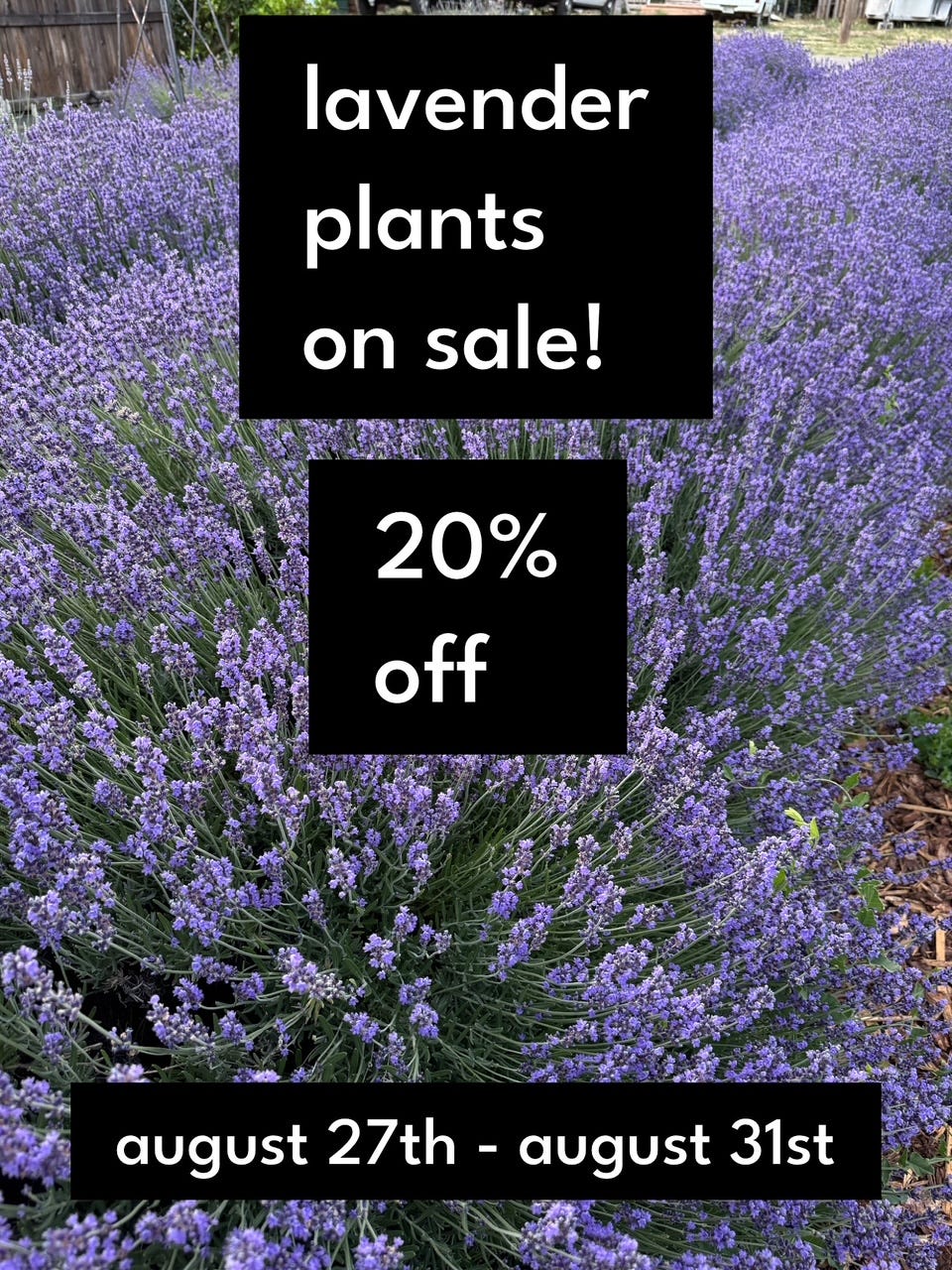
As we continue our countdown to our big fall sale, which begins on Sept 17th, we want to feature some of our favorites on sale each week to whet your appetites for fall planting. This week the sale is on all of our lavenders in stock, 20% off! The sale is from Aug 27th to August 31st.
The Many Shades of Lavender
“There’s a few things I’ve learned in life: always throw salt over your left shoulder, keep rosemary by the garden gate, plant lavender for good luck, and fall in love whenever you can.” That quote from Alice Hoffman’s book and movie ‘Practical Magic’ has always struck me as an herb gardener, a slightly superstitious person and a hopeless romantic. Lavender, with its long history and folklore, intoxicating scent and beauty in the garden is the perfect plant for me, filling all of my senses with joy, mystery and a sense of peace.
For many people, when they think of lavender they picture the beautiful lavender fields of Provence, even though most will never see the fields in bloom. Of course, most of us don’t have a giant landscape to cover with rows of lavender, but rather a container or raised bed, or perhaps a walkway or garden strip where we want to emulate the feeling of lavender bliss. So off you go to your local nursery to buy lavender, quickly finding out that there are many possibilities and you may have to answer many questions before the correct choice can be made. At Morningsun, the many questions often send customers into planting inertia, because all they really wanted was ‘that lavender that smells really good and I can use for stuff’. But answering some questions will assure you get the lavender (or lavenders!) for all of your gardening, cooking and personal uses.
My first question is always ‘What are you going to do with your lavender?’ Yes, I know, grow it and smell it, but there is so much more! Part of the fun of growing lavender is using all of its parts in your life. While it can just be a pretty, fragrant plant in the garden, it also is a powerful medicinal plant, a bee attractor, a cut flower, a culinary plant, used in personal care products and aromatherapy and for crafting.
Second, where will the lavender be grown? In the sun for sure, as lavender needs at least 6 hours of sun and good drainage to thrive. Will the lavender be mixed with other plants, or in a hedge, a raised bed, or a small pot on a balcony? Planting one plant of a dwarf, 1 foot tall variety in a mixed bed will be somewhat underwhelming, while planting a variety that grows to 4 feet tall in a 12 inch pot will only look pretty for a short period of its life. Also, will the plant be right outside a window you look out every day of the year? Perhaps a lavender that flowers at more unusual times of the year, such as in the late fall or early spring, when much of the garden is still dormant and you are in need of some color. Will the plants be close to a pool or sitting area? Some varieties will bloom during the times of the year when you wouldn’t be using a pool, so there wouldn’t be a concern about bees.
How big do you want the lavender to grow? There are lavenders that only grow 10 inches tall, including flowers, and others that are 4 feet or more in full bloom. Each variety grows to a different width, so you can’t plant them all equal distance apart. Ten inch lavenders need to be planted 10 inches apart, but a 4 foot lavender needs at least 30 inches between plants. When planting with other herbs and perennials, you will need to think about how wide each will get. Typically, gardens are overplanted, with everything growing too close together, some plants being lost under others and problems developing with insects and diseases that don’t normally occur in a correctly planted space. And yes, we have all overplanted our gardens. Sometimes you just can’t resist filling in any little tiny space with a plant!
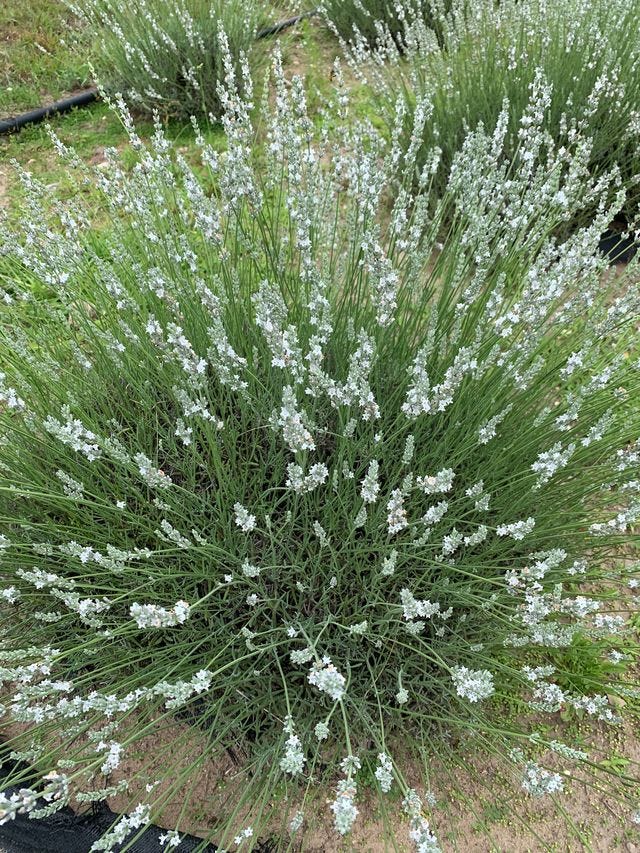
And finally, the question the blows everyone’s mind, what color of flowers for your lavender? Not just lavender colored, but the entire palette of purple. There are light lavender flowers, deep purple, violet blue, and every shade in between. There are also lavenders that have flower petals of one shade of purple, and ‘buds’ of another shade. There are white blooming lavenders, pink blooming lavenders, a yellow blooming lavender, and lavender varieties that are so unusual many people don’t realize they are lavender. Besides flower color, leaves may be deep green, grey, or even silvery white, and leaf structure may be needle like or fern like. It is important to think about the color and structure of the plant, since that is what you will see year round!
So, with so many choices, which lavender is best for your garden? There are 28 species and more than 450 varieties, so plenty of possibilities for every garden. At Morningsun we generally include botanical names, since the common names can be easily used incorrectly. Lavandula angustifolia is English lavender, and all the varieties have sweetly fragrant foliage and flowers. Most of my cooking with lavender is dessert, and I use this species for cookies, ice cream, bar drinks, jelly and tea. The flowers will tint jelly a pretty pink, the ice cream is divinely floral, the tea is aromatic but not medicinal, and the essential oil is sweetly fragrant. Lavandula angustifolia tends to be smaller plants, blooming in May and June and again in mid fall. Flower spikes are short, often only 8 to 10 inches. Some of my favorite English lavenders are ‘Hidcote’, ‘Munstead’, ‘Imperial Gem’, ‘Maillette’, ‘Royal Velvet’, ‘Folgate’ or ‘Melissa Lilac’. Flower colors are intensely deep purple and foliage tends to be green. The ‘Melissa Lilac’ is bicolor deep violet and lavender. And if you are dreaming of gardening in 2026, keep a heads up for Lavandula angustifolia ‘Big Time White’ (with pure white flowers) and La Diva Vintage Violet’. They are sure to add some pizazz to your perennial beds.
Lavandula x intermedia (also called lavandins) are lavenders that grow larger, with more robust and heavy piny fragrance, a strong flavor and long, elegant stems which pair nicely with sunflowers in a vase. These are the lavenders grown in the fields of France and Tasmania. ‘Grosso’ and ‘Fat Spike Grosso’ are widely grown for essential oil, lavender wands and wreaths. ‘Provence’ is a variety grown for dried flower buds for sachets. While these are the two most commonly grown, there are many others, including ‘Gros Bleu’, ‘Abriali’, ‘Hidcote Giant’ and ‘Edelweiss’ (with white flowers) are terrific performers in the garden. They only bloom once, in mid summer, and the foliage is grey. While these lavenders can be used for cooking, they are much better for savory, heavy foods as they will give sweets a ‘soapy’ flavor. The classic ‘Herbes de Provence’ blend uses Lavandula x intermedia.
There have been some exciting new lavandins to be added to the market recently. ‘Phenomenal’ is a variety that looks very similar to ‘Grosso’, but is more cold hardy and also a bit more resistant to having wet feet or clay soil. It is a larger growing plant, 3 ft tall and wide when it is blooming. An interesting note on this variety is that it needs cold temperatures to bloom well, so it isn’t a good selection for the southern states. ‘Sensational’ is a bit more compact, only 30 inches when blooming, with big purple blooms, and plenty of oil that is much lower in camphor. This makes the fragrance of Sensational more like an English lavender, sweeter and more floral. It is hardy to zone 5, but also performs well in hot humid climates - and blooms better without the need for cold. Lavandula x intermedia ‘Riverina Thomas’ was first introduced in Australia, and this selection has many great growing points. It is compact, gray leaved, with long medium purple flowers that are extra large, extra fragrant and can produce up to 5 times the amount of oil as ‘Grosso’. AND as an extra bonus, Riverina Thomas will rebloom in the fall if it is pruned after its summer flowering season.
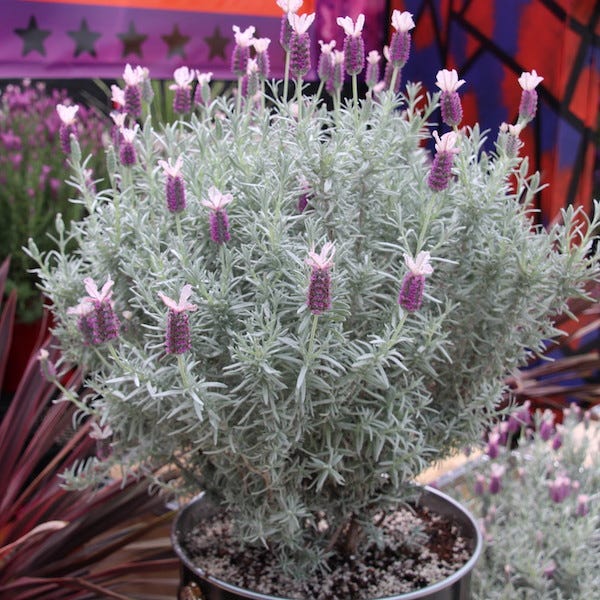
Lavandula stoechas (Spanish lavender) and Lavandula dentata (French lavender) are species that are used in landscaping, but not in cooking or crafting. Spanish lavender blooms very early in the season, in April and May, and if pruned, again in the fall. With ‘butterfly wings’ at the tips of the flowers, it is truly lovely in very dry locations and in containers. The newer varieties such as ‘White Forte’ have white butterfly wings atop fat purple flowers, a real show stopper. Lavandula stoechas ‘Ghostly Princess’ has silvery white leaves topped with bicolor gentle pink blooms that are stunning in the spring and fall. French lavender grows 3 to 4 feet, and tends to bloom almost all year. It is tough and indestructible, so is often planted in difficult areas like parking lots.
If I need lavenders that look pretty in my garden and give flowers for much of the year I choose Lavandula ‘Goodwin Creek Grey’ or Lavandula heterophylla, which both bloom in April, June, November and even December! These are great choices in those locations you will see during the ‘off season’ in the garden.
One final species of lavender that is so different looking that it is often forgotten in Lavandula canariensis, or Canary Island lavender.
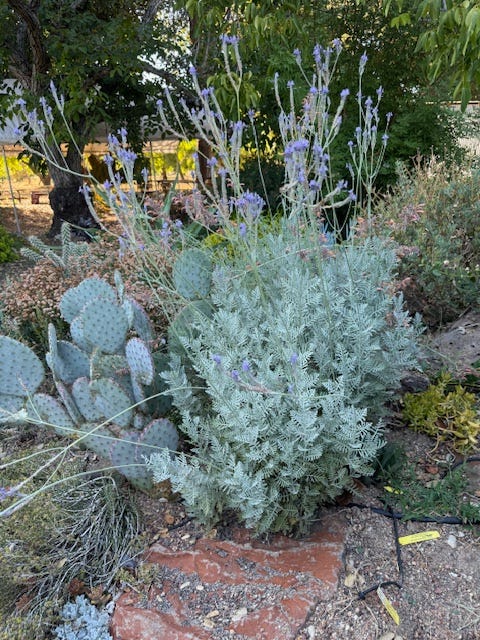
It has unusual waxy fern like leaves and medium purple flowers that are ‘forked’ into 3 segments. It grow 2 to 3 ft tall and wide, and looks perfect pretty much from May until December. It doesn’t smell like lavender and doesn’t have any medicinal or culinary uses but it is a huge attractor of hummingbirds and butterflies, and of course bees. It also is one of the most drought tolerant lavenders I have ever grown, and that means we have really put it to the test. It is also in glorious bloom much of the year, so including it in big mixed pots is a win for long bloom with little work. I keep thinking it isn’t going to survive the winter but this is year 4 out in the garden and it just keeps coming back and growing strong. It will produce some seedlings but is slow to germinate. And who wouldn’t want more of a good thing?
Growing lavender is relatively easy in the California garden. Full sun, good drainage, deep and infrequent watering and regular pruning will keep most lavenders happy. For more information click here for an informative article on growing lavender from our website, or watch a youtube video from our farm about lavender.
Events and Classes Coming Up Next Week
Next Wednesday, Sept 3rd, I will be speaking to the Contra Costa Master Gardeners about waterwise gardening and fall planting. It’s a free class at 10 am at the Master Gardeners working and demonstration garden in Walnut Creek. The gardens are at the corner of Wiget Lane and Shadelands Dr. We will be discussing one of my favorite topics, fall planting, and how to prepare for success for growing your drought tolerant herbs, perennials and California natives. I will bring some fun plants for sale also! Click here for more information.
Also, there are still a few openings in the Tomato Preserving Class being taught from 10 am - 12:30 on Sept 3rd in Lafayette. It is a team taught class with Alexis Koefoed of Soul Food Farm and Stefani Bittner of Homestead Design Collective and there will be all things tomato for the morning (I’m the dessert section, so speaking towards noon, in case you are wondering how I am in two places at once (we all try to do that, right?). Sign up for 2 people and get a 50% discount on the second person!
Many people have been asking for some classes on medicinal herbs, and we begin fall with a weekend full of great hands on herb classes to learn the basics of herbal medicine making. You can take one or two classes or the 4 class series to learn how to make teas, tinctures, creams, supplements and much more. Click here for more information and to sign up. The classes are taught by Brita Wynn Dinsmore M.A., who is an experienced herbalist, anthropologist, ethnobotanist, healer and hedgewitch. She has studied with many well known herbalists in face to face courses and has taught and co taught 25 Gaia Conscious 9 month apprenticeships over the course of the last 30 years. She currently teaches herbal crafting and other classes in Tacoma, WA and has taught herbal intensive and apprenticeships on her own small farm in Shelton, WA.
Projects At the Farm
It’s a bit quiet at the farm this week, as we roll into the last unofficial long weekend of summer. We know you are all eager to plant fall crops very soon though, so we have just stocked in our new 2026 seed from Renee’s seed. Planting seed for lettuce, kale, broccoli and all the other lovely fall crops can really get started in central California. And of course some people want to start their seed hoarding as soon as possible.
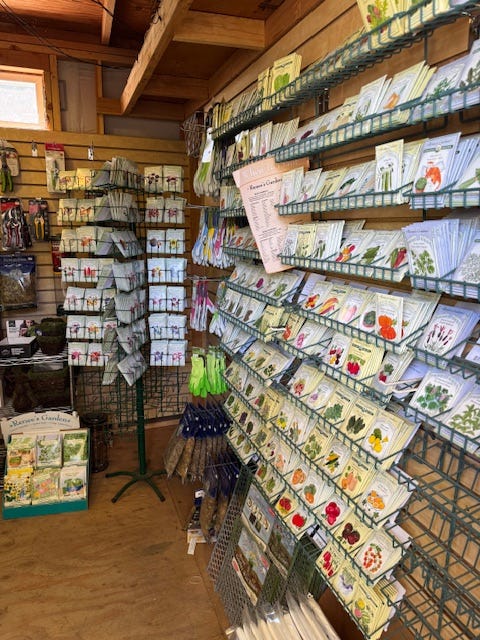
And of course we are clearing out the benches are getting ready to bring out the first round of 6 packs of veggie starts the first week of September.
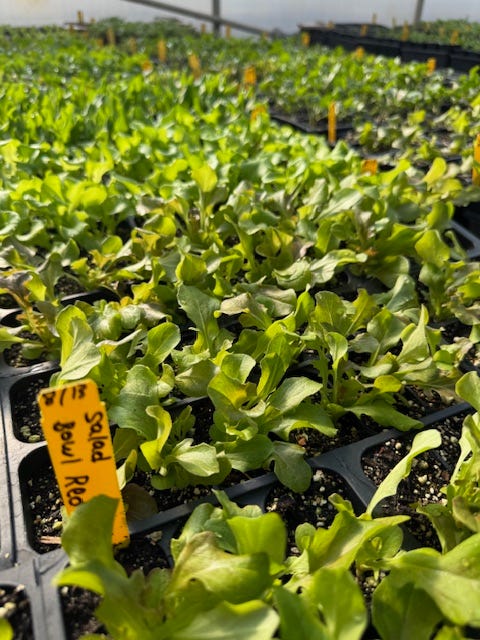
Don’t panic though, we will have plenty of fall vegetables throughout September and October.
September 20th will be our annual Open Farm Day - we will have a tea tasting, extra farmers for the day and much more!
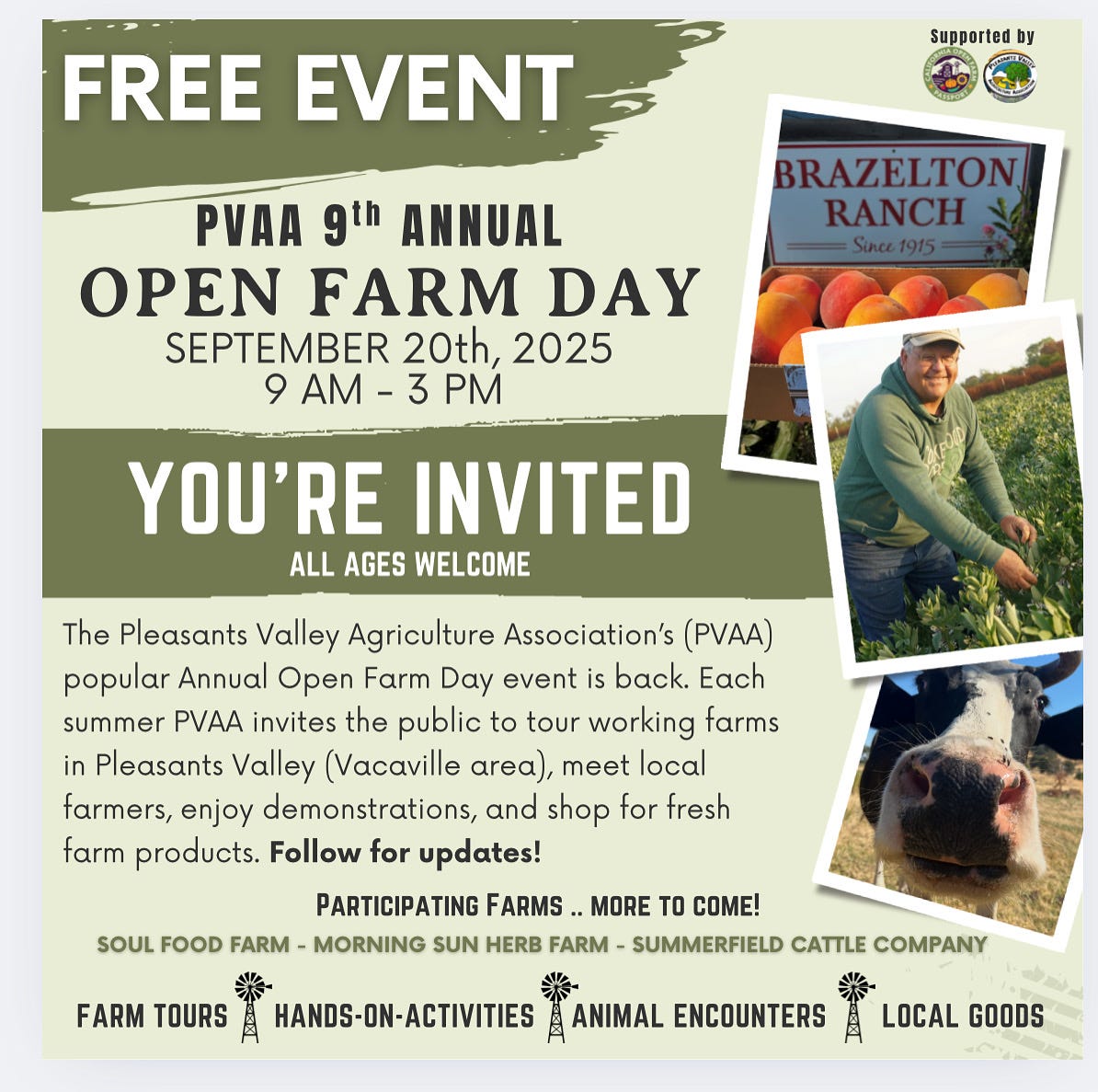
Don’t miss out on Open Farm Day! Follow Pleasants Valley Ag Association on facebook an instagram for more information on events during the day.