
Ticking Down To the End of the Year
Two Weeks to Quiet Time at Morningsun
Only six more open days at Morningsun Herb Farm before we close for our Christmas break. We aren’t actually closed after Christmas but still working in the greenhouses, producing lots of baby plants, pruning and doing clean up. We can move at a much slower pace in early January, and perhaps sleep in a bit if the doggies will let us.
Last Saturday’s Christmas Fair was the last big hurrah for the year, and Santa Donkey (aka Leroy) was happy to receive plenty of attention with pets and carrots.


When the carrots ran low, Santa Leroy was none too happy!
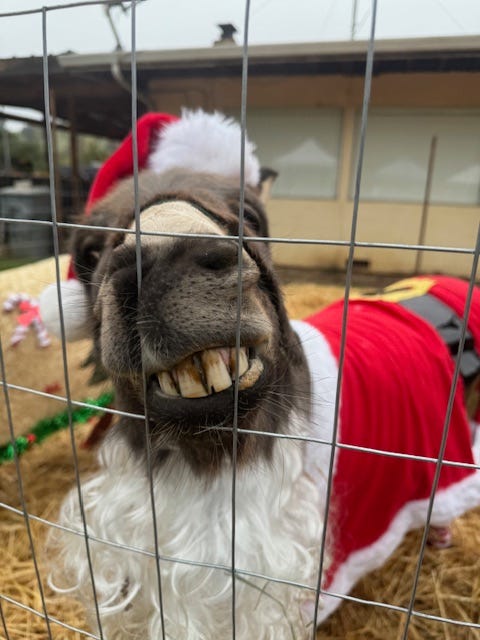
Kidding of course, Leroy is so cuddly and sweet, I would even let him roam through my house - when the husband is away of course. He is one photogenic little donkey, and super patient to wear a beard and a hat all day.
Thanks to all of the wonderful vendors who came out to join us for the day, and thanks to all our customers who braved the cold temperatures to enjoy an old fashioned on-the-farm experience.
_______________________________________________________________________________________
Our last day open for the year will be Sunday, December 21st. For these last days, we have everything at the farm on sale 20% off. From seeds, soil and plants to wind chimes, essential oil and herbal teas, it’s on sale! Veggie 6 packs are 50% off, and if you check out at the register while it is raining ask for the ‘rainy day’ discount to get an additional 10% off. That is a bonus for those of you who read the newsletter. Our hours are Thursday through Sunday, 10 am - 4 pm.

Why are Plants So Important in Our Holiday Rituals?
Now is the time to deck the halls, decorate the Christmas tree and hang the mistletoe. Why are these plant related traditions associated with this holiday season? For gardeners, the shortest day of the year, December 21st, can only mean one thing – longer days and spring is coming! For ancient peoples, particularly the Celts, life outdoors exposed them to the annual ebb and flow of daylight, and rituals revolving around plants to ward off the darkness and “evil spirits”, bring fragrance into the house and celebrate the coming of spring were important in their daily lives.
The best known plant of Christmas is undoubtedly the Christmas tree. Nature worshipping Druids many millennia ago would decorate trees outdoors with apples to signify fertility and candles to honor the sun god. Centuries later the Romans decorated trees similarly to honor the god of agriculture Saturnus and the sun god Solarus. Bringing the Christmas tree indoors may have come directly from the Romans practice. The first written record referring to a Christmas tree is from a German book dated 1604, and may be attributed to Martin Luther. Ironically, the Christmas tree probably came to America via German speaking soldiers hired by the British to fight the colonists during the American Revolution. After the war they remained in their newly adopted country and decorated their Christmas trees as they had done in Europe.
Those of us who have tried to remove the parasitic shrub mistletoe from our landscape don’t consider this plant sacred, but the ancient Druids and later the Greeks considered it very magical, since it grew from the mighty oak trees. But why kiss under a parasite? Tracing the history of kissing under the mistletoe means going back to ancient Scandinavia. It was the plant of peace in Scandinavian antiquity. If enemies met by chance beneath it in a forest, they laid down their arms and maintained a truce until the next day. This ancient Scandinavian custom led to the tradition of kissing under the mistletoe. Mistletoe was banned throughout the Middle Ages in Germany because the Church considered it “dangerous and heathen”.
Poinsettia is the favorite Christmas plant here in the U.S, and the number one flowering potted plant in the country. It is native to Mexico, and was cultivated by the Aztecs as a symbol of purity. Later Franciscan priests used it in Nativity processions, and it gained the Spanish name “flor de nochebuena”, or Christmas night flower. In 1825 Joel Poinsett, the first US Ambassador to Mexico and an accomplished botanist, fell in love with the plant and brought it back to the US, where he distributed it to many botanical gardens. By the 1950’s poinsettias were widely distributed and for greenhouse growers proved a huge money maker at a time when their greenhouses were usually empty.
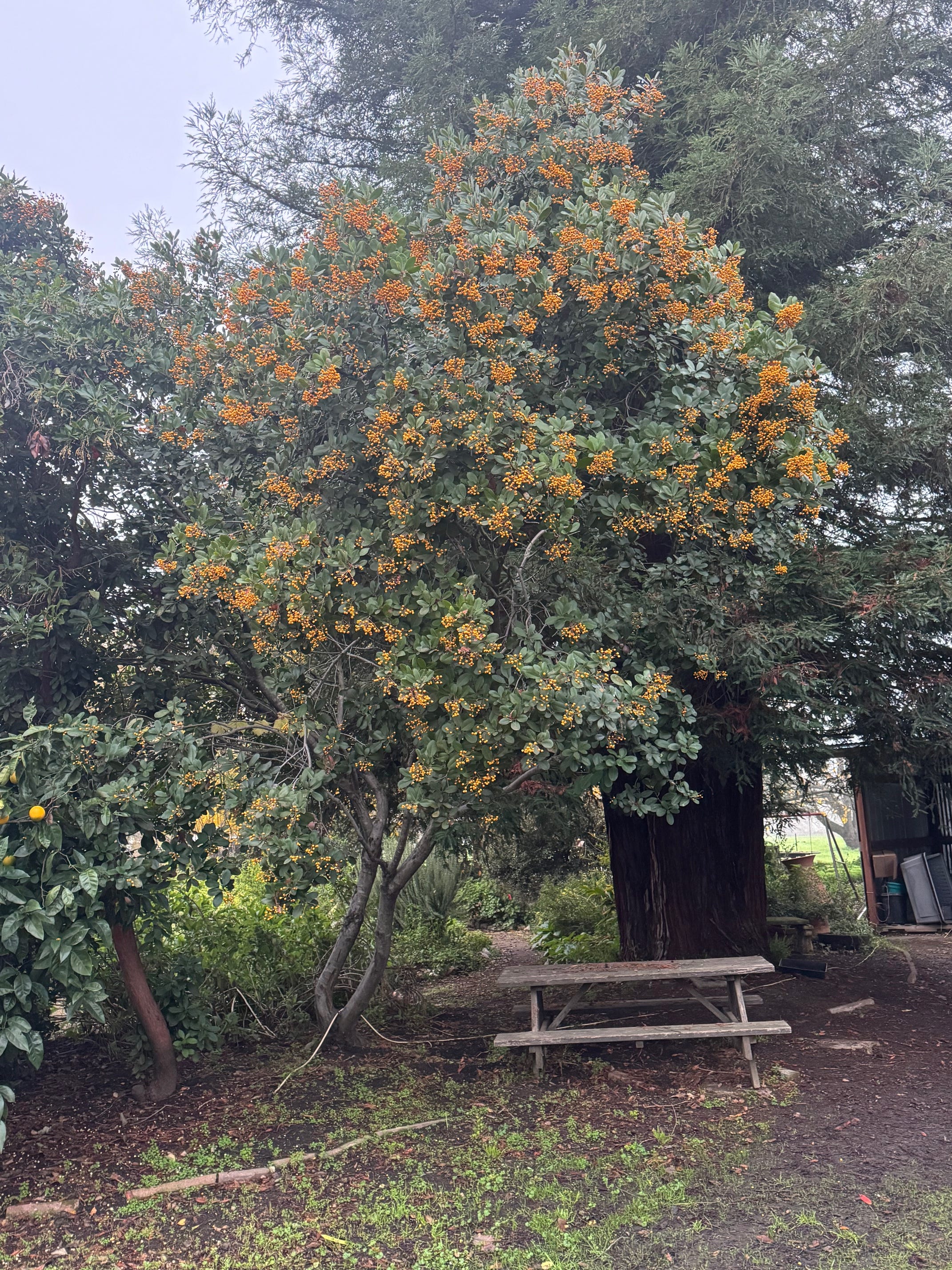
Evergreen holly was another sacred plant, especially during the winter when it looked beautiful with its red berries. The pointy leaves were believed to ward off witches and lightening, and branches were brought indoors during the winter months to give shelter to the fairies, those tiny spirits of the forest. Holly wreaths were adopted by the Christians to symbolize Jesus Christ’s crown of thorns, with the red berries symbolizing his blood. Here in California, we can easily replace the red berried holly with the native toyon, Heteromeles arbutifolia. Here at the nursery we have the yellow berried version, ‘Davis Gold’, which is a stunning addition to the winter landscape.
_____________________________________________________________________________________
This Week’s Project at the Nursery
This week our entire crew and many of the volunteers who helped during the year met for dinner at Pietro’s #1 in Vacaville, to celebrate another successful year at Morningsun.
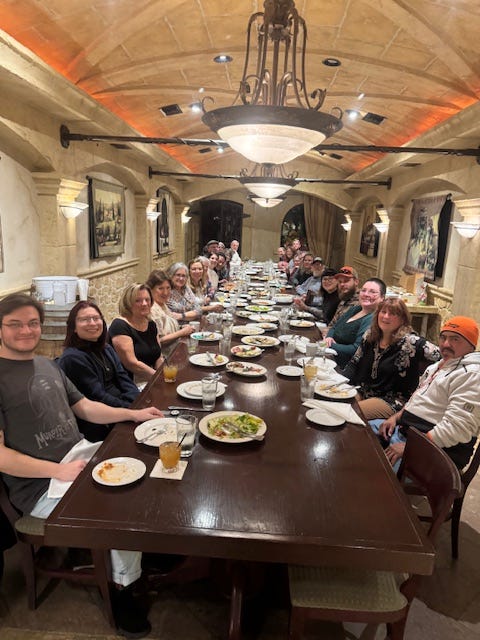
Lots of great food, drinks, and a chance to dress up different from our usual nursery attire. And one small gesture by Dan and I of gratitude for all of the hard work it takes to keep the nursery full of plants and gardening products.
____________________________________________________________________________________
I saw this quote in the Sacramento Master Gardeners Gardening calendar (click here to buy the 2026 calendar), I think it describes the shortest days of the year perfectly: